On the stolen land of the Blackfeet, Ktunaxa, Salish, Cayuse, Umatilla, and Walla Walla peoples.
This post is about my 2022 thru attempt. I’m not currently thru-hiking and will not be in the 2024 season. I’ll announce concrete plans when I have them.
What About Bob?
The Bob is one of the most complained about sections of the CDT by both NOBO and SOBO hikers. It’s rugged, extremely remote, and long. If done in combination with the Scapegoat Wilderness, it’s over 200 miles of trail with only one iffy resupply option at Benchmark, 120-something miles in. It was my first SOBO taste of the CDT I remembered from the Gila National Forest in New Mexico. In some sections it was well marked and very easy to follow. In others, dead trees from burn scars, and both dead and live trees from windstorms, had been dropped in every direction like a game of pick up sticks. That left us to climb hand-over-hand over them, often without a place to touch the ground in between. I followed an itinerary written by Spicey Bite, a hiker from the hostel in Glacier, who was now several days ahead of me. It was named the Super Duper Xtreme Kitchen Alternate (it was an expanded version of an alternate dubbed the kitchen Alternate, which was posted in the kitchen at the hostel), and the itinerary shaved off miles and hoped to avoid some of the more treacherous sections of downed trees and overgrowth. Following the itinerary was a risk because we didn’t always have up to date information about the alternates and they weren’t in FarOut/Guthook, but not following it meant more miles and several sections of trail conditions that we knew for a fact would be poor. A lot of long-distance backpacking is risk management, and this was no different.
I was filled with a certain unease. Glacier had not felt like as much of a warm up as I’d hoped it would be and I was walking into the Bob, one of the most remote sections of the entire trail, expecting rivers that might be impassable for much of the day if not multiple days at a time, following an itinerary none of us had tested and with a goal average mileage that I hadn’t hit once yet on this trip. On paper, it sounds completely idiotic. In reality, it was again, a risk and resource management problem. I packed extra food, I had back-up navigation, I could backtrack, I was aware of all the available alternates, and while I was technically alone, there were people within a day of me both ahead and behind, and those were just the ones I knew about. If the rivers were impassable, I would wait. If the trail stopped existing or became impassable halfway through an alternate, I could backtrack to the CDT, which we knew from Butte flippers should (barring poor river conditions) be passable the whole way through. If I hit a section that I couldn’t get through due to blowdowns, I could try side trails or backtrack to East Glacier. If I got hurt, I had a sat phone. If I got eaten by a bear or struck by lightning… yeah, nope, didn’t have a plan for those ones. You can’t control for everything.
Entering the Bob
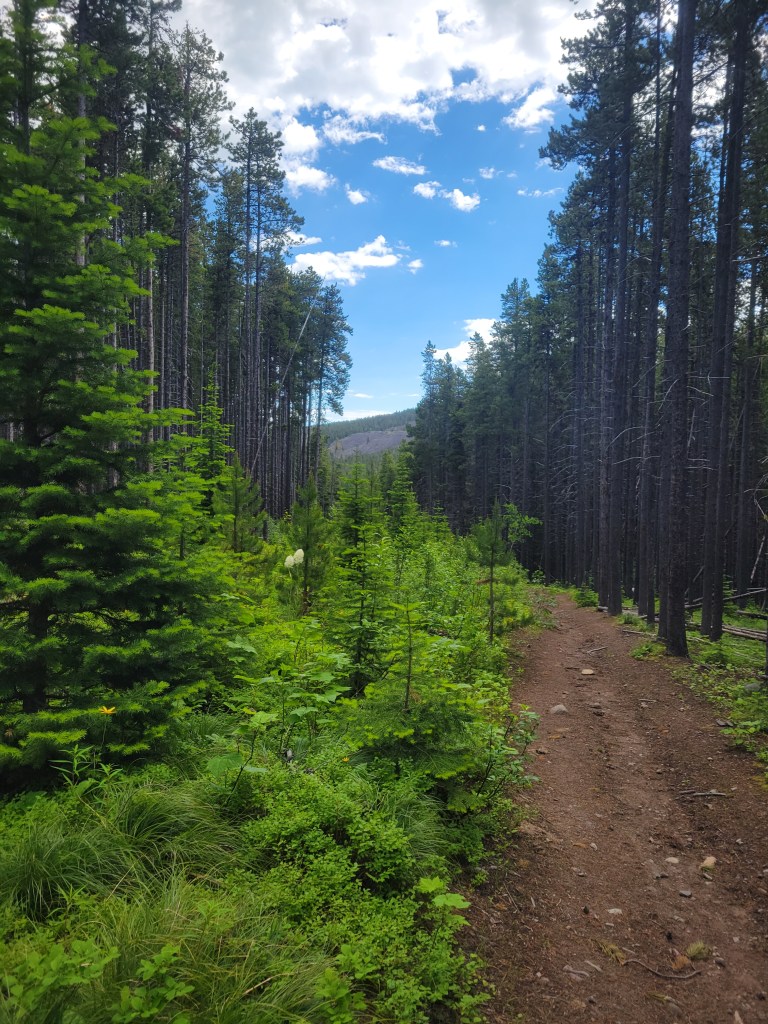
I caught a ride to the entrance to the Bob Marshall Wilderness and stepped from the pristinely maintained trails of Glacier into the more rugged and remote trails of the USFS land, which is what the CDT is known for. The training wheels were off, big time.
I went, listening to an audiobook and calling out, a bit wearily, to warn off any bears. I’d heard of black bears the size of mini-vans in the forest and I wasn’t keen on the idea of running into any of them, either. The first step of the Super Duper Xtreme Kitchen Alternate was called just the Kitchen Alternate, and it was the only alternate that we really knew anything about. It was a section of side trail that had been cleared, and that bypassed a part of the CDT with hellish blowdowns. The river crossings had mixed reviews, but they were all reasonable. I was so, so grateful for my time in the Gila, which had taught me a lot about judging currents and crossings, and about what I was comfortable with fording on my own. I knew how to best use trekking poles and was comfortable with positioning my weight and the weight of my pack to promote balance. I was able to make the judgment calls and found that they were sound. I finished the Kitchen Alternate and found the red-line again, moving right along. See, the Bob is not so bad. It’s just like any other section, just a bit longer and more remote. The act, the movement, your movement, it’s the same. And it was true. The Bob was not all that different from everything else I’d done.
The problem, as it would continue to become apparent, was that I was different. The first night, I found some other hikers and set up around them, grateful for their company. We ate dinner together, watched the sun as it started to set (Montana gets an insane amount of light this time of year), and watched a deer as it walked around in a meadow.
The Alternate and a Wet Bag
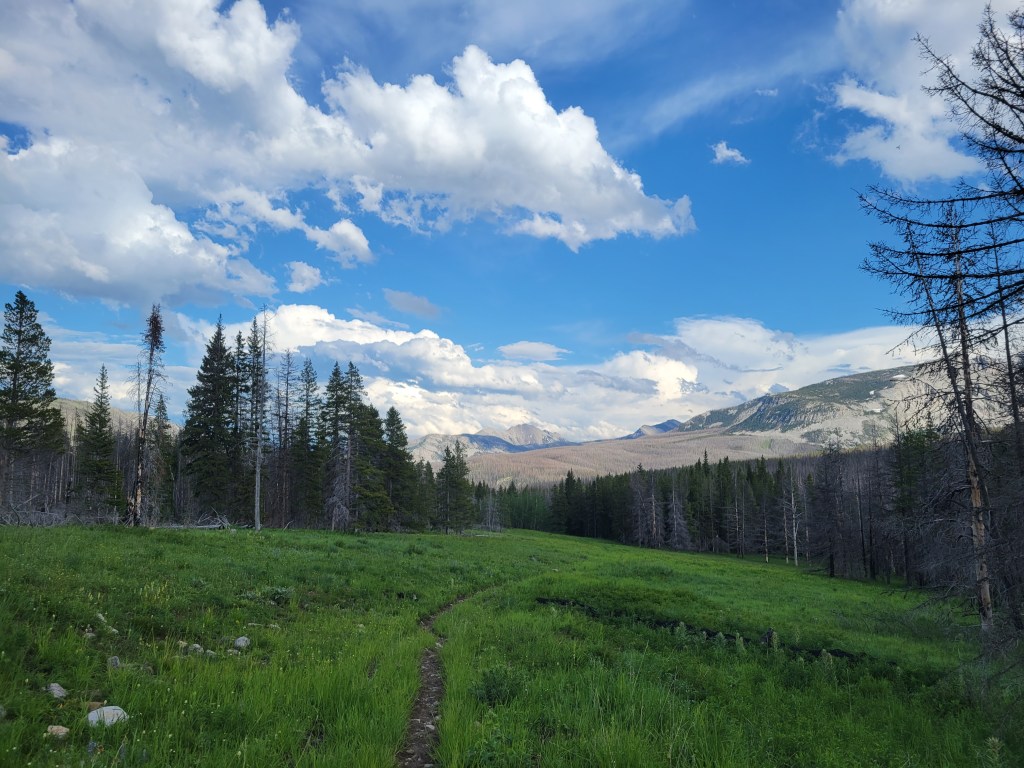
The next morning I got a late start. I followed the red line initially, before branching off on the second section of the Super Duper Xtreme Kitchen Alternate. I lost the trail a couple of times in the beginning which was a little nerve wracking, but I did eventually find it and it became much clearer as I dropped down to a flat area. There were a few blowdowns but it was well maintained and easy to follow, making for a pretty easy morning. This was where I started to realize that my pack might be broken. It would not sit flat on my back, instead pulling at one shoulder no matter how the straps were adjusted. I stopped, took everything out of my pack while shouting to scare off any bears who might be chilling in the woods, and repacked everything in the hope that it would help. It did help a little, but I couldn’t get it comfortable. Day 2 of an 8-day stretch is not the best place to have a critical piece of gear start to fail, but it wasn’t a big enough problem for me to turn around.
Eventually I met back up with the red line and ended up camping with two of the hikers I’d camped with the night before, Bodega and Achilles, who I’d actually met at East Glacier. We camped near an alpine lake and there were so. Many. Mosquitoes. It made Lake Elizabeth Foot in Glacier look almost bugless. I had to pee after I got into my tent and when I got out, I saw an actual swarm of mosquitoes big enough to move the way large flocks of birds move, and the scariest thing on trail stopped being grizzlies for a minute. I ran as far away from my tent as I could and crouched behind a tree, peeing faster than I ever have in my life and then sprinting back to my tent.
Aaaaand the condensation was so bad that I woke up to a sleeping bag that was not moist or damp, but wet. This, friends, is why you don’t sleep by water sources. It gets complicated in places like the Bob, though, because often the areas close to water sources are what gets spared during wild fires, so they might be the only places with living trees.
I was worried the footbox was saturated past the point of no-return, and I have a down sleeping bag. For those who did not just feel their heart speed up, down doesn’t insulate when it’s wet. Montana wasn’t getting as cold at night as the desert, only about half my bag was wet, my base layers were dry, and I still had a dry puffy coat. I could have wrapped my puffy coat in my rain jacket and shoved that in the footbox of my sleeping bag if I had to, or otherwise made some sort of makeshift solution, but it was kind of terrifying. Fortunately, the morning was sunny and after the ground dried off, I took a break to sun dry my rain fly and sleeping bag. Somehow, by some miracle, the bag was not past the point of no return and dried out just fine, but the fear had been intense and real and had made me feel so vulnerable. Day 3 of an 8-day stretch is a terrible place to have a critical gear failure. And my pack still wouldn’t sit correctly, causing me to spend a solid chunk of the day attempting to adjust it into a comfortable position. I had to hope the reduction in weight as I continued to eat my food would be enough to get me through the section, and then go from there.
The Thunderstorms
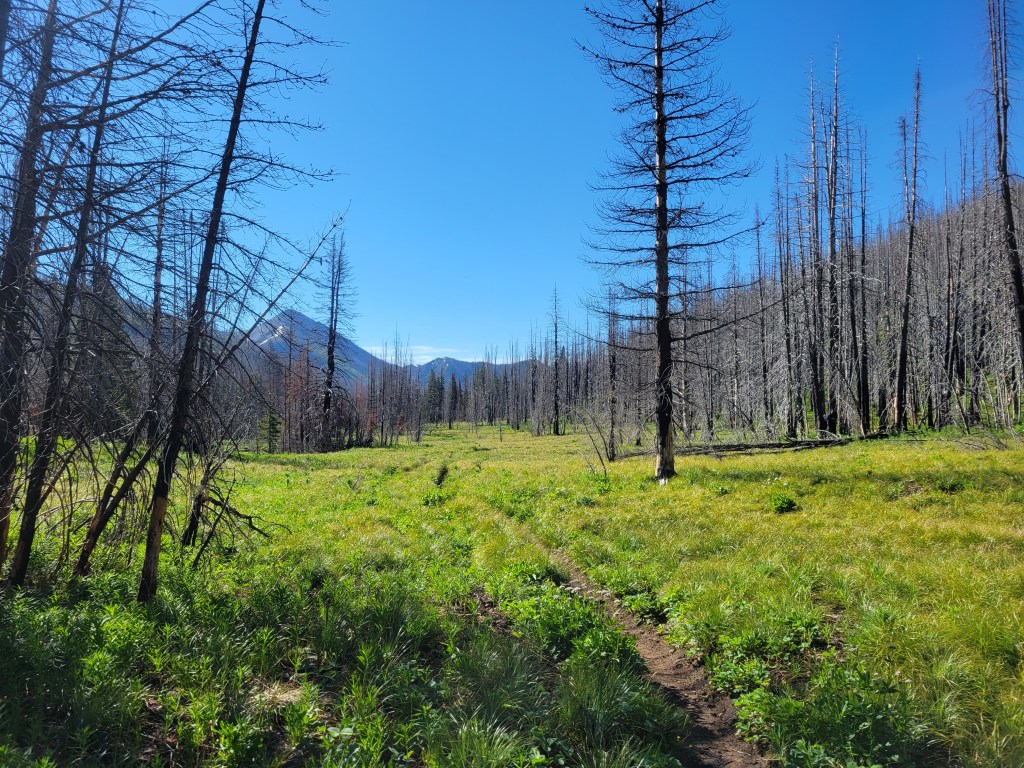
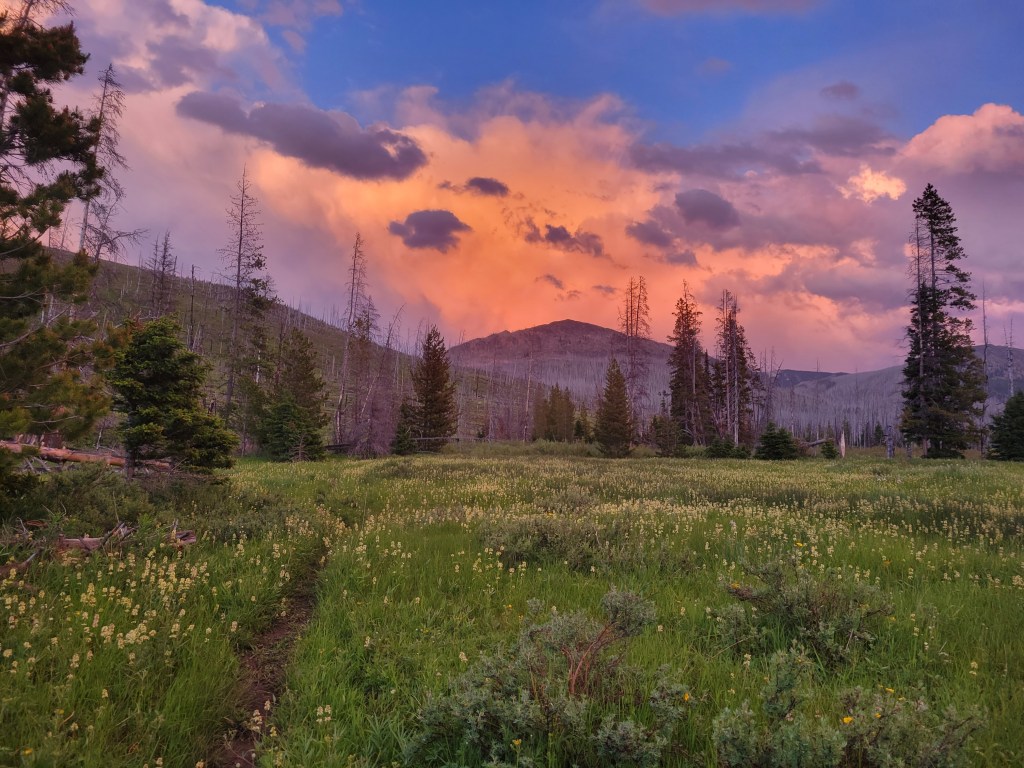
I’ve backpacked in thunderstorms before, and they’re not my favorite experience, but this was my first time being in a bad situation in a thunderstorm. I’d been lucky that all the other ones I’d experienced had been in heavily wooded areas. I was miles into a burn scar that continued as far as I could see in every direction, and most of the dead trees had fallen, so it was a meadow littered with matchsticks, with the occasional burned trunk sticking up ten or twenty feet. I saw the clouds roll in and sped up, because I knew I didn’t have time to backtrack to live forest. There was a good chance that going forward wouldn’t help me either, but I couldn’t stay put.
There was nowhere to go, and the storm rolled in fast. I was the tallest thing in the area apart from the occasional lightning rod dead tree. Lightning struck the hillsides all around me, and I watched, hearing the almost instantaneous thunder and wondering if this would be the last day of my life, if I would die alone in the Bob Marshall. A few minutes later, I found a ditch, took my pack off, walked away from it, and crouched. I sent a “Not dead” message with the InReach so that search and rescue would be able to find my body if I were to get struck. I’d left my pack away from me so that if I was burned to a crisp, I could be easily identified by my gear. It began to hail. I crouched in the lightning stance and waited. The statistical odds of getting struck by lightning are higher than you might think when backpacking, but they’re still pretty low. It doesn’t feel that way in essentially an open field in a bad storm.
The storm passed, and not all the trees were still standing at the end (hearing them fall is eerie), but I was. I got up, strapped my pack on, picked up my poles, and kept going, heading down into a meadow in the valley that had very few live trees.
Another storm rolled in while I was in the meadow. Again, I saw it coming. Again, there was nothing to do but continue until I could either find a safe place to hide, or until it passed. There was nowhere to hide, and the storm passed before I could find a spot. Lightning struck around me again, but it never hit quite as close as it had during the first storm. I got lucky, it moved through more quickly than the first, over maybe fifteen minutes after it started.
I kept going, headed for the next place I knew had an area where I could camp (a small section of live forest adjacent to, you guessed it, a water source), and reached there right around dusk. I fell asleep alone to the sounds of wolves howling in the distance, relieved that the storms were over and that, if more rolled in, I was finally in the safest place I could be to weather them.
 Marin on the CDT